
The government recorded a deficit of approximately $1.78 trillion in 2025, while total debt surpassed $39 trillion, partially driven by high interest payments. Here’s the picture for 2026 including Social Security obligations.
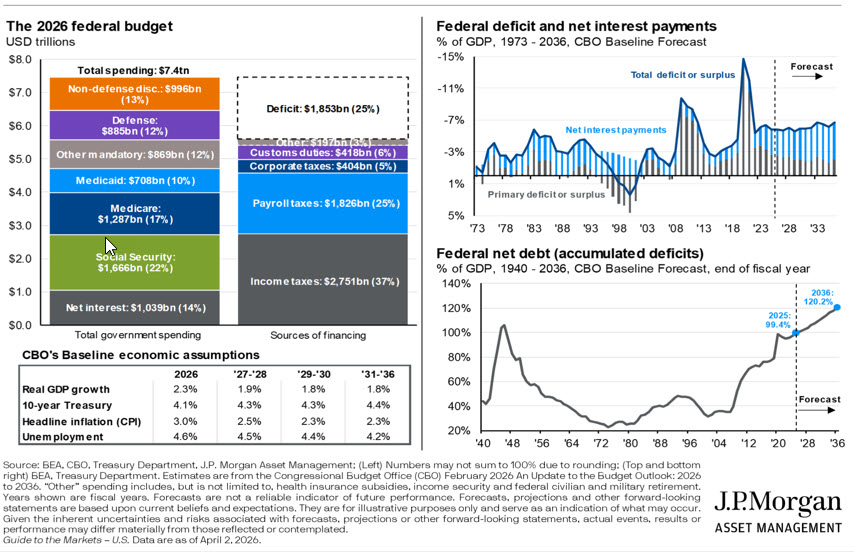
Meanwhile, total Social Security benefit payments for 2025 were about $1.6 trillion – and the Congressional Budget Office (CBO) projects the trust fund will be depleted in 2032. If this fund isn’t replenished, it’s estimated that only about 72% of promised benefits will be paid.
Social Security likely won’t go away; but, just as likely, there will be changes – possible gradual changes in benefits, taxes, and/or retirement ages.
This has prompted many investors to fill in the retirement income gap. No wonder those with a floor of income have more confidence in their retirements than those who don’t. Naturally, this confidence is a product of the relationship between the size of their asset base and spending levels.
That said, Social Security is unlikely to disappear. About 75% of benefits are funded by ongoing payroll taxes. It’s the other 25% that’s at issue.
Higher interest rates don’t directly fund or defund Social Security, but they do impact the broader financial picture since they impact trust fund interest. A good recommendation might be to build a retirement income plan stress tests multiple scenarios: lower Social Security income, higher healthcare costs, longer life expectancy, and market volatility.
If you’d like some help, tell me your priorities. This will give us something to talk about.
Jim
Thanks to JPMorgan for providing the above image. JPMorgan and The Independent Financial Group are not affiliated.