
It’s simple, but not simplistic.

Is tax-managed investment management, even for ‘tax-delayed’ accounts, like your 401(k) and IRAs, etc., important?
Yes, but probably not the way you think.
You’re probably wondering why you would need tax-managed investment management inside a tax-deferred account.
Well, you don’t. Actually, it’s more about asset location.
Remember, the size of your 401(k) someday will determine the size of your required minimum distributions (RMDs) – do you know what tax brackets will look like when you retire? You not only may not like your new tax bracket; but, you may get a surprise when you find the size of your RMD also impacts how much of your Social Security is taxed, as well as your Medicare premiums. Hmmm. You may want to grab some coffee and take a look at this video about how tax planning changes during the four stages of retirement.
All good financial planning begins with these basic pillars:
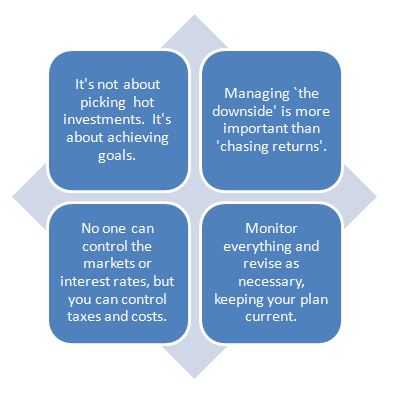
Inflation, interest rates, and the markets are all concerns; but these concerns, while not in our control, can be managed. One thing we do have some control over taxes and costs. It comes down to a sound strategy tied to a solid plan. You can’t manage taxes with funds or ETFs: they’re both baskets of pooled money. But, you CAN replicate an index in a cost-efficient and tax-efficient way.
Tax optimization – one controllable – is key.
For tax-deferred accounts, a strategy for controlling future account balances is important before being forced to take required minimum distributions (RMDs) in the future. Those distribution levels will impact taxes on Social Security benefits and also Medicare premiums.
For table accounts, investors need a strategy that goes beyond mutual funds and ETFs – one that allows for a more customized investment experience that mirrors the attributes of a selected index while providing enhanced transparency and a more individualized approach to the investment process.

And, it makes sense: Core tax strategy vs. pooled investments

This approach delivers a range of potential benefits, including:
- Cost efficiency (the other controllable variable) – Do not incur commission fees at the manager level. It’s passively managed with respect to an index rather than picking stocks.
- Transparency and direct ownership – Instead of owning a share in a pooled vehicle, like a mutual fund or ETF, investors actually own the individual stocks and bonds in their accounts. Note: bond funds and bond ETFs do not have a maturity date. When you own bonds, you know they will mature at face value on their maturity dates, regardless of market gyrations in the meantime. Stocks, of course, can be managed for tax-harvesting.
- Personalization – The ability to personalize all aspects of a portfolio to truly align with an investor’s priorities and needs.
Building your financial future? It’s like building your dream home. Hire an an experienced architect. Building your dream future? Well, you know. You need a good blueprint, either way. Otherwise, you might not like the outcome.
What does the basic process look like?
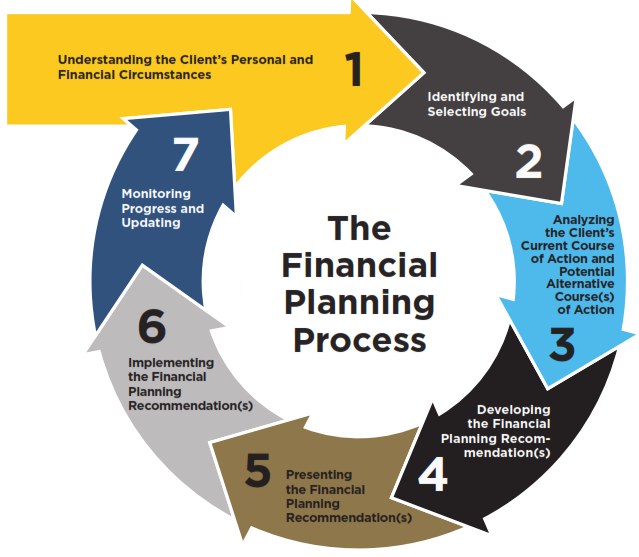
- It begins with you. You can’t find the store you want in the mall until you find that X on the mall directory that says ‘you are here’. You wouldn’t want your doctor to prescribe a treatment without conducting an examination and providing a diagnosis. This step should be no surprise to anyone.
- It’s best to know what you want your house to look like before we begin ordering out materials.
- Has what you’ve been doing so far been working? Can it be improved?
- A preliminary plan is developed, however….
- Planning is a collaborative process. This is where your input and tweaking may be necessary to arrive at the final approach everyone is comfortable pursuing: you have to be comfortable knowing it’s exactly what you want and I have to be comfortable it’s in your best interest and we’re not doing anything stupid.
- The plan is implemented, and…
- We have regularly scheduled meetings to monitor your progress and make sure we’re on-track. Remember Pillar #1 at the top of this page: we don’t care if we beat indexes – the only index that matters is if you’re achieving your financial goals.
So, why would you consider working with an independent fiduciary advisor?
- Independent and Objective. Financial planning and investment advisory services are provided on a fee-only basis. IFG does not accept commissions or third party compensation for these services. Insurance products, which do not require ongoing management oversight, are not included on the annual fee structure. Compensation for the use of these products, where desired, is derived from the insurance carrier..[1]
- Minimize expenses. Use passive low-cost investments wherever feasible. Use active institutional management when value can be added to reduce volatility, increase predictability, and/or increase tax efficiency.
- Clear Responsibilities and Limits. A fiduciary advisor is just that – an advisor. IFG does not take custody of, or have access to, client assets at any time. Client assets are held in the client’s name at an approved independent third-party custodian. Learn more here.
- Clear compensation. Planning fees are quoted in advance on a defined-project basis. As for investment management and oversight, it’s simple: IFG does better when clients do better. All fees are clear and fully disclosed.
- Fiduciary Status. As a Registered Investment Advisor, IFG embraces fiduciary status on all client investment accounts. This means a client’s best interest can be the only consideration. I am willing to put my fiduciary status in writing. Learn more about the fiduciary standard Download the The Fiduciary Standard.
Every client deserves, and has the right to expect, an objective and unbiased advisor who is fully aligned with the client’s goals, possesses a moral compass with strict standards of accountability, and who takes a straightforward, common sense collaborative approach, putting the client in control of a hassle-free process incorporating state-of-the-art technology with unparalleled flexibility, openness, and transparency.
Service is paramount: extraordinary service with no surprises, no excuses, and no worries, coupled with independent thinking and lasting solutions to help clients achieve the security, stability, predictability, and peace of mind they seek.
Would you like to have a fiduciary advisor help you navigate the financial marketplace? I’d be happy to help!
- Tell me your priorities here, then
- Arrange your introductory ‘right fit’ phone call today using our convenient scheduler!
It’s easy, and of course, you’re under no obligation.
Jim